Stream Fordlandia online in english with english subtitles 720
Fordlandia : NPRIntroduction NOTHING IS WRONG WITH ANYTHING January 9, 1. Henry Ford was in a spirited mood as he toured the Ford Industrial Exhibit with his son, Edsel, and his aging friend Thomas Edison, feigning fright at the flash of news cameras as a circle of police officers held back admirers and reporters. The event was held in New York, to showcase the new Model A. Until recently, nearly half of all the cars produced in the world were Model Ts, which Ford had been building since 1.
But by 1. 92. 7 the T’s market share had dropped considerably. A half decade of prosperity and cheap credit had increased demand for stylized, more luxurious cars. General Motors gave customers dozens of lacquer colors and a range of upholstery options to choose from while the Ford car came in green, red, blue, and black— which at least was more variety than a few years earlier when Ford reportedly told his customers they could have their car in any color they wanted, . It was costing a fortune, estimated by one historian at $2.
River Rouge factory, which had been designed to roll out Ts into the indefinite future, had to be refitted to make the A. Yet on the first two days of its debut, over ten million Americans visited their local Ford dealers to inspect the new car, available in a range of body types and colors including Arabian Sand, Rose Beige, and Andalusite Blue. Within a few months, the company had received over 7.
A, and even Ford’s detractors had to admit that he had staged a remarkable comeback. The New York exhibit was held in the old Fiftieth Street Madison Square Garden, drawing over a million people and eclipsing the nearby National Car Show. All the many styles of the new model were on display at the Garden, as was the Lincoln Touring Car, since Ford had bought Lincoln Motors six years earlier, giving him a foot in the luxury car market without having to reconfigure his own factories. But the Ford exhibit wasn’t really an automobile show. A few even got to see Henry himself direct operations.
Stopping to give an impromptu press conference in front of an old lathe he had used to make his first car, Ford said he was optimistic about the coming year, sure that his new River Rouge plant— located in Ford’s hometown of Dearborn, just outside of Detroit— would be able to meet demand. No one raised his recent humiliating repudiation of anti- Semitism, though while in New York Ford met with members of the American Jewish Committee to stage the . Most reporters tossed feel- good questions.
One wanted to know about his key to success. The previous August he had taken his first airplane ride, a ten- minute circle over Detroit in his friend Charles Lindbergh’s Spirit of St. Louis, just a few months after Lindbergh had made his historic nonstop transatlantic trip.
Ford bragged that he . Ford then announced that he would soon fly to the Amazon to inspect his new rubber plantation. I would never spend 2.
So Edsel stepped forward to explain. The plantation was on the Tapaj. Amid all the excitement over the Model A, most barely noted that the Ford Motor Company had recently acquired an enormous land concession in the Amazon. Inevitably compared in size to a midranged US state, usually Connecticut but sometimes Tennessee, the property was to be used to grow rubber. Despite Thomas Edison’s best efforts to produce domestic or synthetic rubber, latex was the one important natural resource that Ford didn’t control, even though his New York exhibit included a model of a rubber plantation. And they reported the enterprise as a contest between two irrepressible forces.
On one side stood the industrialist who had perfected the assembly line and broken down the manufacturing process into ever simpler components geared toward making one single infinitely reproducible product, the first indistinguishable from the millionth. On the other was the storied Amazon basin, spilling over into nine countries and comprising a full third of South America, a place so wild and diverse that the waters just around where Ford planned to establish his plantation contained more species of fish than all the rivers of Europe combined. It was billed as a proxy fight: Ford represented vigor, dynamism, and the rushing energy that defined American capitalism in the early twentieth century; the Amazon embodied primal stillness, an ancient world that had so far proved unconquerable.
- There was a huge clash of culture between mechanized America, Ford's utopian ideals and the way the.
- Fordlandia The Rise & Fall of Henry Fords Forgotten Jungle City by Greg Grandin available in Hardcover on Powells.com, also read synopsis and reviews.
- Find album reviews, stream songs, credits and award information for Fordlandia - Jóhann Jóhannsson on AllMusic - 2008 - The second installment in Jóhann.
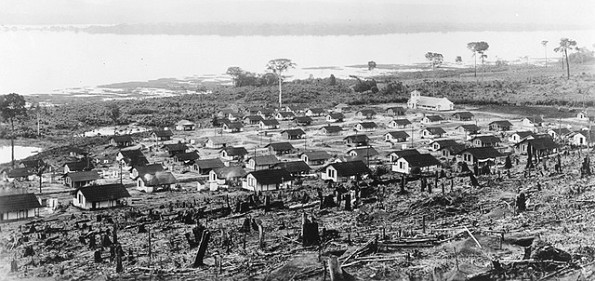
- From 1928-1945, the Ford Motor Company built the Fordlandia and Belterra plantations in an attempt to establish a permanent rubber plantation presence in Brazil.
- From The Henry Ford Archive of American Innovation. For more related artifacts on Fordlandia or Belterra, visit The Henry Ford's Digital Collections.
- Directed by Emerson Muzeli. Today in Detroit (USA), an American woman trying to understand her recurring dreams and searching for explanations, she finds out that she.
- To attract workers to Fordlandia, Ford offered a range of services – including an 18-hole golf course and dance hall. Photograph: The collections of Henry Ford.
Fordlandia: The Rise and Fall of Henry Ford's Forgotten Jungle City . The stunning, never before. Greg "Fordlandia: The Rise and Fall of Henry Ford's Forgotten Jungle City", 2009, isbn=0805082360; Referências. NPR coverage of Fordlandia: The Rise and Fall of Henry Ford's Forgotten Jungle City by Greg Grandin. News, author interviews, critics' picks and more.
A new and titanic fight between nature and modern man is beginning. Having convinced himself, based on a combination of archival research, deduction, and clairvoyance, of the existence of a lost city (which he decided to name . He was never heard from again. In the case of Ford, who had all the resources of the industrial world at his disposal, journalists had no doubt about the outcome, and they reported on his civilizing mission in expectant prose.
Time reported that Ford intended to increase its rubber planting every year . Black Indians armed with heavy blades will slash down their one- time haunts to make way for future windshield wipers, floor mats, balloon tires. The word quixotic has its origins in a story set on the Spanish plains, in the same century when Europeans were first entering the Amazon. It’s often applied to those entranced by the promise of jungle riches, as certain of the existence of the object of their pursuit as the Man from La Mancha was that the windmills he tilted at were giants. Pagbabalik Ni Santi watch in english with english subtitles 1440. The richest man in the world, he was the gilded one— the .

fordlandia